
You’ve hashed out the details of buying a home. From price per square foot to…
How to Read a Closing Disclosure Before You Sign
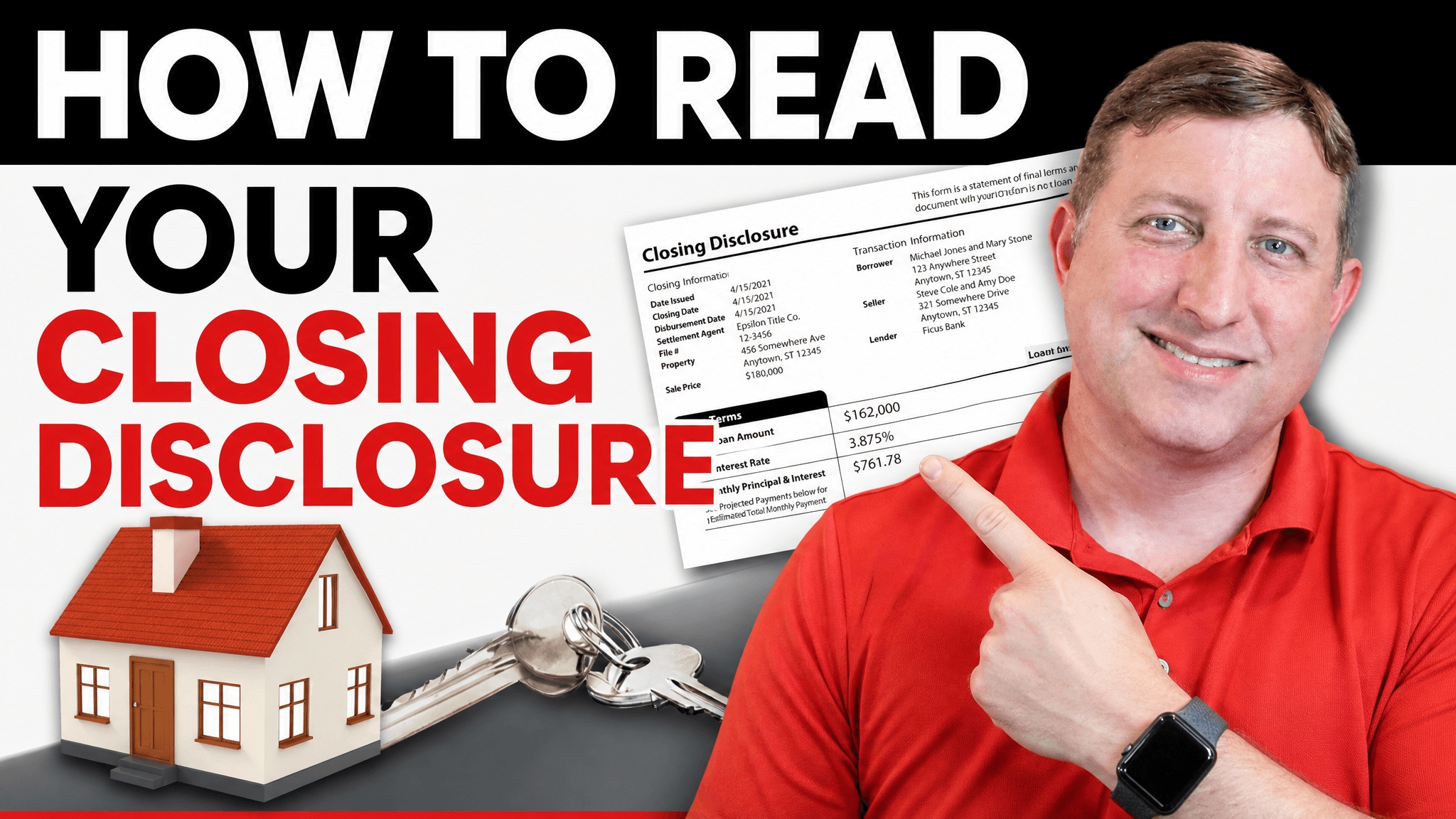
A closing disclosure is the final document your lender sends before you sign your mortgage.
It lays out every cost, fee, and loan term that will appear at the closing table, and federal law requires your lender to deliver it at least three business days before closing so you have time to review it carefully.
Most buyers receive it, skim it, and assume everything looks fine, but that assumption can be expensive.
The closing disclosure is the last opportunity to catch errors, question unexpected fees, and confirm that the numbers match what was discussed throughout the process.
📝 What a Closing Disclosure Is
A closing disclosure is a standardized five-page document required on most mortgage transactions.
It replaced the older HUD-1 Settlement Statement and covers:
- Final loan terms including the interest rate and loan amount
- A full breakdown of closing costs
- Prepaid items like property taxes and homeowners insurance
- The exact amount of cash needed to close
- A summary of how funds flow between buyer and seller
The three-business-day review window is not optional.
If a material change occurs after the disclosure is sent, the lender must issue a revised version and the three-day clock restarts.
How the Closing Disclosure Connects to the Loan Estimate
When you applied for the mortgage, the lender sent a loan estimate within three business days.
- That document showed projected costs.
- The closing disclosure shows final costs.
Comparing the two side by side is one of the most important steps in the review process.
Most fees cannot increase significantly between the loan estimate and the closing disclosure without a valid reason.
When a fee exceeds the federal tolerance limits, the lender must cover the difference.
Reviewing both documents together helps identify:
- Fees that increased without explanation
- New charges that did not appear on the loan estimate
- Changes to the interest rate or loan terms
- Credits or seller concessions that are missing
🏡 Page 1: Loan Terms and Projected Payments
Page one is where the core loan details live.
Review each of the following:
- Loan amount: Confirm it matches what was agreed upon
- Interest rate: Verify it matches the rate lock confirmation
- Rate type: Confirm whether the rate is fixed or adjustable
- Monthly principal and interest: This should match the payment discussed during the application process
- Estimated taxes, insurance, and assessments: These are the escrow components added to the base payment
- Prepayment penalty: Confirm none exists unless it was specifically discussed
- Balloon payment: Confirm none exists on a standard mortgage
- Total cash to close: The final amount needed at the closing table
If any of these figures differ from what was discussed, ask for an explanation before the closing appointment.
Page 2: Closing Costs Breakdown
Page two is the most detailed section and the one most likely to contain surprises.
It breaks costs into three categories:
Loan costs
These are fees charged by the lender for originating the loan:
- Origination charges and application fees
- Points paid to buy down the rate
- Underwriting fees
Services the borrower did not shop for
These are required third-party services selected by the lender:
- Appraisal fee
- Credit report fee
- Flood determination fee
Services the borrower did shop for
These are required services the borrower was permitted to choose:
- Title search and title insurance fees
- Settlement or closing agent fees
- Survey fee if applicable
Other costs
These include:
- Prepaid interest covering days between closing and the first payment
- Property tax and insurance escrow deposits
- Government recording fees
- Transfer taxes if applicable
Compare each fee to the loan estimate.
Any fee that increased beyond the allowed tolerance should be questioned.
💸 Page 3: Cash to Close and Transaction Summary
Page three shows two items:
- A table that calculates the final cash-to-close
- A summary of the full transaction
The cash-to-close table shows how the final amount was calculated, including any changes since the loan estimate.
If the number increased, the table should make clear why.
The transaction summary shows how money flows between buyer and seller.
Review this section to confirm:
- Earnest money already paid is credited correctly
- Seller concessions negotiated in the contract appear as credits
- Any deposits already made are reflected accurately
- The purchase price matches the contract
Missing credits are among the most common errors on closing disclosures and among the easiest to fix when caught early.
Page 4: Loan Disclosures
Page four covers specific loan features and the escrow account setup.
Escrow account
If the loan includes an escrow account, this section shows what will be collected monthly and what the starting balance will be.
Review:
- Which costs are being escrowed, such as taxes and insurance
- The initial escrow deposit amount
- Whether an escrow waiver applies
Other loan features to confirm
- Whether a future buyer can assume the loan
- Late payment policies and grace periods
- Any negative amortization provisions, which should not appear on a standard mortgage
🧮 Page 5: Loan Calculations and Contact Information
Page five shows the full long-term cost of the loan and lists everyone involved in the transaction.
Loan calculations
- Total of all payments made over the life of the loan
- Finance charge showing the total cost of borrowing
- Annual percentage rate reflecting the true cost including fees
- Total interest percentage showing interest as a share of the loan amount
These numbers are useful for understanding the full cost of the mortgage, not just the monthly payment.
Contact information
This section lists names, companies, and license numbers for the lender, mortgage broker, real estate agent, and settlement agent.
Confirm the information is accurate and matches the professionals involved in the transaction.
The closing disclosure is where last-minute errors or misunderstandings can be caught and corrected before closing. Don’t skim it.” — Wade Betz, Winning With Wade | Mortgage Education and Strategy
What to Do if Something Looks Wrong
Finding a discrepancy on the closing disclosure is not a reason to panic.
It is a reason to ask questions before signing anything.
Contact the lender and real estate agent immediately when:
- A fee increased significantly from the loan estimate without explanation
- A credit or concession from the contract does not appear
- The interest rate does not match the rate lock confirmation
- The loan amount or loan terms changed
- A new fee appears that was never discussed
Some changes require the lender to issue a revised closing disclosure and restart the three-day review period.
That may delay closing by a few days, but it is far better than signing a document with unresolved errors.
📍 Texas-Specific Items to Watch
Texas has a few closing details worth paying close attention to:
- Property tax proration can vary significantly depending on the closing date and county assessment schedule. Confirm the prepaid tax amount reflects the actual tax rate for the property.
- Title insurance in Texas is state-regulated, meaning the premium is set by the Texas Department of Insurance. The seller customarily pays for the owner’s title policy, but confirm this was negotiated in the contract and reflected on the closing disclosure.
- HOA dues and any transfer fees should appear if the property has a homeowners association. Verify the amounts match what was disclosed during the transaction.
- Seller concessions negotiated for closing cost assistance must appear as a credit on the transaction summary. If they are missing, flag it immediately.
Closing Disclosure Review Checklist
Before signing:
- Compare the closing disclosure to the loan estimate line by line
- Confirm the interest rate matches the rate lock agreement
- Verify the loan amount and loan terms are correct
- Check that earnest money and seller concessions appear as credits
- Review all lender fees and confirm none increased beyond the allowed tolerance
- Confirm property tax and insurance escrow amounts are accurate
- Review the cash to close total and confirm funds are available
- Check page five for the APR and total interest percentage
- Confirm all contact information is accurate
- Ask about any fee or line item that is unclear before closing day
📣 Frequently Asked Questions (FAQs)
What is a closing disclosure?
A closing disclosure is a federally required five-page document that outlines all final loan terms, closing costs, and the exact cash needed to close. Lenders are required to deliver it at least three business days before the closing appointment.
How is the closing disclosure different from the loan estimate?
The loan estimate shows projected costs early in the process. The closing disclosure shows final costs and must be compared to the loan estimate to identify any changes or unexpected fees.
Can fees change after I receive the closing disclosure?
Most fees are locked at that point. Changes are permitted only in limited circumstances, such as a rate change or last-minute negotiated repairs. Material changes require a revised disclosure and a new three-day review period.
What should I do if I find an error on the closing disclosure?
Contact the lender and real estate agent immediately. Do not wait until the closing appointment. Most errors can be corrected quickly when caught early, but some may require a revised disclosure and a short delay.
Do I have to sign the closing disclosure before closing?
Signing the closing disclosure acknowledges that you received and reviewed it. It is not the same as signing the final loan documents. Never sign under pressure if questions remain unanswered.
What is the three-day review period?
Federal law requires lenders to deliver the closing disclosure at least three business days before closing. This gives buyers time to review every detail, compare it to the loan estimate, and raise any concerns before the closing appointment.
What happens if the cash-to-close amount is higher than expected?
Contact the lender immediately to understand what changed. The cash-to-close table on page three should show any increases and explain the reasons. If the increase is not explained, request clarification before proceeding.

About the Author
Wade Betz
Mortgage Broker at Winning WIth Wade · NMLS #280613
Wade has been a stalwart in the mortgage industry since 2006, dedicating himself to helping thousands of families navigate the complexities of home financing. With so much experience, he stands out as a leading mortgage originator in the Dallas-Fort Worth area.
Specializes in: DSCR Loans, VA Loans, Reverse Mortgages
Licensed in: AL, AZ, AR, CA, CO, CT, FL, GA, ID, IL, IN, KS, LA, MD, MI, MS, MT, NE, NJ, NM, NC, OH, OK, OR, PA, SC, TN, TX, VA, WA, WI
Related Posts