Two homeowners insurance policies can carry the same coverage limit and still pay you very…
How to Finance a New Build on Land You Own
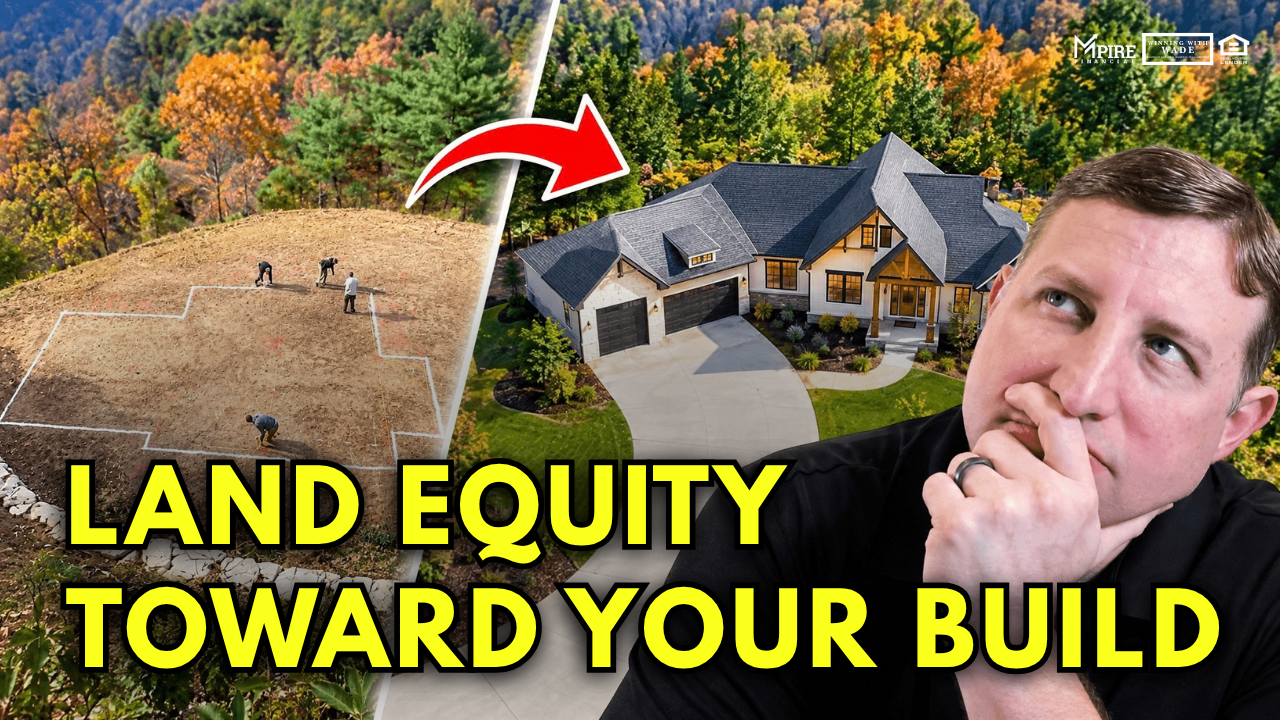
Many people who own a lot assume they need to save a separate cash down payment before they can build.
If you plan to build on land you own, the land itself may cover some or all of that down payment.
How much your land counts depends on how you got it, how long you’ve owned it, and how much you still owe on it.
Each loan program weighs those factors differently, so knowing the rules before you choose a loan helps you get the most from your lot when you build on land you own.
🔍 How Land Equity Works
Land equity is the part of your land you own outright.
Lenders find it by taking the land’s value and subtracting what you still owe on any land loan.
If your lot is worth $70,000 and you owe $10,000, you have $60,000 in land equity.
If you own the lot free and clear, your equity equals the land’s full value.
When you build on land you own, a lender can count that equity toward your down payment, meaning less cash out of pocket at closing.
Each loan program decides which land value it uses, and that choice can change your equity by thousands of dollars.
Why Six Months Matters
If you build on land you own with an FHA or conventional loan, the key number is six months of ownership.
Many buyers assume they need to wait a full year, and that mix-up can push a building timeline back for no reason.
FHA and conventional loans use six months for different purposes:
- FHA uses six months to decide how much of your land’s value counts.
- Conventional loans that follow Fannie Mae rules use six months to decide whether you can take out extra cash.
VA and USDA loans don’t use a six-month rule.
Keep this free Land Equity Comparison Chart handy as you plan to build on land you own.
Using Land for an FHA Loan
FHA offers a one-time close construction loan, which is a single loan that pays for building your home and becomes your mortgage once the home is done.
Land you already own can count toward the down payment on this loan, based on rules HUD includes in its guidelines.
FHA checks how long you’ve owned the land on the date your lender gets your FHA case number.
How FHA values your land depends on how you got it and how long you’ve had it:
- Bought six months ago or less. FHA uses the lower of two numbers: the price you paid or what the land appraises for today.
- Bought more than six months ago. FHA uses today’s appraised value, even if the land is now worth more than you paid.
- Received as a gift or inheritance. FHA uses the full appraised value, since you never paid a purchase price.
After FHA sets the value, any amount you still owe on the land comes off the top, giving you your equity.
FHA limits credit on recent purchases because an appraisal right after someone buys land can jump quickly.
The six-month wait gives the property time to hold its value before it counts toward your loan.
FHA Land Equity Examples
These three hypothetical examples show how much land equity FHA would count:
- You bought recently. You paid $50,000 for a lot six months ago and still owe $20,000. As long as the lot appraises for at least $50,000, FHA uses your $50,000 purchase price, and your equity is $30,000.
- You’ve owned it for two years. You paid $50,000, the lot now appraises for $70,000, and you owe $10,000. FHA uses today’s $70,000 value, so your equity is $60,000.
- You inherited it. The lot appraises for $100,000, and you owe nothing on it. Your equity is the full $100,000.
If you plan to build on land you own with an FHA loan, start by writing down when you got the land, how you got it, and what you still owe, since those three facts decide your number.
If you’ve owned land for years or received it as a gift, this FHA rule usually works in your favor.
If you’ve owned land for years or it came to you as a gift, this FHA rule usually works in your favor.” — Wade Betz, Winning With Wade | Mortgage Education and Strategy
Using Land for a Conventional Loan
Conventional loans that follow Fannie Mae’s construction-to-permanent rules turn your construction financing into your long-term mortgage once the home is built.
If you only need money to build on land you own, you can use this financing no matter how long you’ve owned it.
Six months only comes into play if you want the loan to give you extra cash beyond what it costs to build:
- Owned less than six months. Your loan follows standard rate-and-term rules, which means the cash-out refinance option isn’t available yet.
- Owned six months or longer. Your lender can set up the loan as a cash-out refinance, which gives you more flexibility in how you use the money.
If you plan to build on land you own and also want cash out, tell your lender up front, since that goal changes how the loan gets set up.
Using Land for a VA Loan
If you build on land you own with a VA loan, there’s no six-month rule.
What matters to VA is whose name is on the title and what the land is worth today.
Veterans have two ways to finance a build with VA:
- A VA one-time close construction loan. One loan covers the build and your long-term mortgage, and your land equity counts toward the down payment no matter how long you’ve owned it.
- A construction loan followed by a VA loan. A standard construction loan pays for the build, and once the builder finishes the home, you refinance into a VA loan. Your land equity covers the down payment on the construction loan and carries over into the VA loan.
Few lenders fund the building phase of a VA one-time close loan, so most veterans use the second path.
A lender that offers VA mortgages may not offer VA construction loans, so ask before you apply.
VA loans also have no mortgage insurance, and veterans with a qualifying VA disability rating may not have to pay the VA funding fee.
Getting Cash Back With VA
When you switch from the construction loan to your VA loan, you can choose a standard VA loan that pays off what you owe or a VA cash-out refinance.
The cash-out refinance can hand some of your land equity back to you if the finished home appraises for more than you owe.
A hypothetical example shows how this could work:
- You own land worth $80,000 and owe nothing on it.
- Your land covers the down payment on a $350,000 construction loan, so you borrow $270,000.
- The finished home appraises for $350,000 or more.
- You can refinance into a standard VA loan for the $270,000 you owe, or use a VA cash-out refinance to take some of your land equity back at closing.
Texas has its own home equity rules, so this cash-out option works this way only if you build on land you own outside Texas.
If your land is in Texas, or if getting cash back later is part of your plan, talk it through with your lender before you choose a construction loan.
Using Land for a USDA Loan
USDA loans are typically zero down for eligible borrowers, so your land usually has no down payment to cover.
Owning your land outright still has value if you plan to build on land you own with USDA financing.
Whether you qualify for USDA in your area is its own question, and a lender who works with all of these programs can help you answer it.
⚖️ Which Loan Fits Your Land
When you build on land you own, your situation points you toward the program that gives your land the most weight:
- If you’ve owned your land for years, FHA uses today’s appraised value, which can work in your favor if the land has gone up in value.
- If you inherited your land or received it as a gift, FHA counts its full appraised value.
- If you bought your land recently, FHA counts the lower of your purchase price or today’s appraisal.
- If you want extra cash beyond building costs, a conventional loan can work as a cash-out refinance once you’ve owned the land for six months.
- If you’re a veteran, VA skips the six-month wait and, outside Texas, can hand some of your land equity back through a cash-out refinance.
- If you qualify for USDA, you may not need a down payment at all.
Steps to Build on Land You Own
Before you apply, work through these steps:
- Confirm your ownership. Gather your original purchase documents if you bought the land, or make sure the title is in your name if you received it as a gift or inheritance.
- Know your dates. Figure out when your ownership started, since six months matters for FHA and conventional loans.
- Know what you owe. Find your current balance on any land loan, since it comes off your land’s value.
- Decide what you want the loan to do. Know whether you only need money to build or also want cash out.
- Choose an experienced lender. Look for a lender who has closed FHA one-time close, Fannie Mae construction-to-permanent, or VA construction loans, since lenders handle construction loans differently.
- Plan your appraisal with your lender. If you’ve owned the land for more than six months, today’s appraised value sets your equity, so let your lender coordinate the appraisal for your loan.
With these facts in hand, a lender can tell you how much your land covers when you build on land you own.
✅ Build on Land You Own Checklist
- Gather your original purchase documents.
- Confirm the title is in your name if you received the land as a gift or inheritance.
- Write down the date your ownership started.
- Find your current balance on any land loan.
- Decide whether you want cash out beyond building costs.
- Ask lenders whether they’ve closed construction loans on the program you plan to use to build on land you own.
- Ask whether your lender funds VA one-time close construction loans if you’re a veteran.
- Ask how Texas home equity rules affect a VA cash-out refinance if your land is in Texas.
- Coordinate your appraisal with your lender if you’ve owned the land for more than six months.
Frequently Asked Questions (FAQs)
Can you build on land you own without a cash down payment?
Your land equity may cover some or all of the down payment on FHA, conventional, and VA construction loans. How much it covers depends on the loan program, your land’s value, and what you still owe on it.
How long do you need to own land for FHA to count its full value?
FHA counts today’s appraised value once you’ve owned the land for more than six months. Before that, FHA uses the lower of your purchase price or the appraisal.
Does inherited land count toward an FHA down payment?
FHA counts the full appraised value of land you inherited or received as a gift. Any amount you still owe on the land is subtracted from that value.
Do you need to own your lot for six months for a conventional construction loan?
You can use Fannie Mae construction-to-permanent financing no matter how long you’ve owned the lot. The six-month mark only matters if you want extra cash out beyond building costs.
Does VA have a waiting period for using land equity?
VA has no six-month rule for land equity. VA looks at whose name is on the title and what the land is worth today.
Can a VA loan give you cash back for your land?
Outside Texas, a VA cash-out refinance can hand some of your land equity back at closing if the finished home appraises for more than you owe. Texas has its own home equity rules, so this option works differently there.
Does land equity help with a USDA loan?
USDA loans are typically zero down for eligible borrowers, so your land usually has no down payment to cover. Owning your land outright still has value, and a lender can tell you whether you qualify for USDA in your area.
What should you do first if you want to build on land you own?
Gather your ownership documents, know how much you owe on the land, and decide whether you want a cash-out refinance. Then choose a lender who has closed construction loans on the program you plan to use.

About the Author
Wade Betz
Mortgage Broker at Winning WIth Wade · NMLS #280613
Wade has been a stalwart in the mortgage industry since 2006, dedicating himself to helping thousands of families navigate the complexities of home financing. With so much experience, he stands out as a leading mortgage originator in the Dallas-Fort Worth area.
Specializes in: DSCR Loans, VA Loans, Reverse Mortgages
Licensed in: AL, AZ, AR, CA, CO, CT, FL, GA, ID, IL, IN, KS, LA, MD, MI, MS, MT, NE, NJ, NM, NC, OH, OK, OR, PA, SC, TN, TX, VA, WA, WI
Related Posts